03 November 2011

The right stuff

Remember my recent post about an office with a view?

Well, it seems that several people involved in recruiting at Airservices Australia believe I have what it takes to become an air traffic controller, because this morning I got offered a job. I start on the tower course in May next year.

This means I'll be spending most of next year living in Melbourne, we'll be moving down there just as it's starting to get cold in May. Once I finish the academy training, I'll get posted to a tower somewhere in Australia (we have 28 towers around Oz) for on the job training, then I'll be a fully fledged ATC. I could be the person, when you go on holiday, that lets you land at which ever airport I end up working at. I could even conceivably be the person that gives permission to land to all sorts of royalty, presidents, etc, even John Travolta who flies his own 707 and often comes down under.

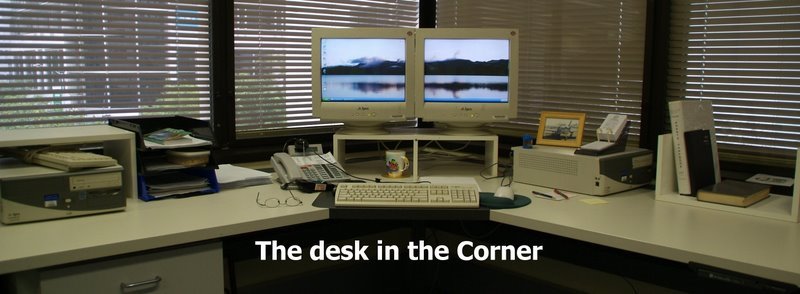
Not that I'm going to let the power go to my head. I could end up here.

13 October 2011

The balloon has gone up

I'm not actually sure what that phrase means, I think it has something to do with a situation getting serious. In my case, it has to do with watching a weather balloon being launched at Brisbane airport this morning.

As well as my application to become an air traffic controller, I also have an application in to become a meteorology observer. I have an interview coming up soon, so this morning I went out to the met station at Brisbane airport to see what the observers do.

Around 9am every morning (and again at 9pm) they send up a weather balloon with a radiosonde attached. The radiosonde transmits temperature and humidity data, and the balloon is tracked by radar to get the wind speed and direction at different altitudes. At 3am and 3pm, smaller balloons are sent up without the radiosonde, just to get the wind data.


Above is the balloon ready to be remotely inflated with hydrogen. The reflector is just alfoil stuck to styrofoam and the radiosonde hangs underneath.


If you look closely, you can see the radiosonde hanging below the balloon. It ascends at around 1000ft per minute, so it disappears from view pretty quickly. The radar tracks it automatically until the balloon bursts at around 35000 ft or higher.


The round building above is where the balloon is inflated and released from. The warning light with the yellow sign flashes when the balloon is being inflated, because the hydrogen in the balloon is so flammable. The observers ring the control tower to let them know they're about to launch, but at night the guys in the tower can see the light flashing and already know why they're ringing.


Observations are taken regularly using the gear shown in the photo above. There's stuff there to measure soil temperatures, evaporation rates, air temperature and humidity, cloud heights, horizontal visibility and even a glass ball that burns a piece of paper to measure the amount of sunlight per day. The white thing about a quarter in from the left of the pic is a laser that measures the cloud height.


The round thing above is what they use to measure evaporation rates. It's covered in mesh, probably to stop frogs breeding in it, and they top it up each day to see how much it had evaporated. The thing near the bottom left corner of the pic has five thermometers in it to measure soil temperature at different depths. The thing to the left of the evaporation tank (or pond) is the glass ball that measures the daily sunlight.


Everyone has probably seen the white boxes that hold thermometers, there's one in the middle of the above pic. There's also a couple of rain gauges there. The brown thing near the middle of the pic is actually a museum piece that used to measure rainfall rates on a rotating paper chart.

If I end up getting a job with the bureau, I'll be trained how to use all this gear, and could be doing the job anywhere in Australia, that includes Australia's Antarctic stations, Lord Howe and Norfolk Islands. Or I could end up working at Brisbane airport.

Fingers crossed, the interview is on the 24th.

12 September 2011

An office with a view

How would you like to work in an office with a view like the one below?


That's the view from the tower at Brisbane International Airport, looking west toward the city. I used to work in the city, and all I could see out my window was the walls of other buildings. It's not hard to guess where I went for a visit today.

A couple of months ago, I applied for a job as a trainee air traffic controller. I've gone through the online test stage and the phone interview, and next week I have a full day of interviews and other assessments. If I'm successful there, I'll have a full year of training in Melbourne ahead of me, before returning to Brisbane to finish off my training as an enroute controller. Today I paid the control centre a visit to get an idea of what's involved in the job.

I could explain what goes on at Brisbane Centre, but the Air Services Australia website does a better job of that.

Even though I'm applying as an enroute controller, I still got to spend about an hour up in the tower, and what a view.


Above is the view across Moreton Bay out toward Moreton Island with a couple of Virgin Blue 737s.


The domestic terminal. The international terminal is to the right of the tower.


Off in the distance, behind the refinery, is Wellington Point, where I sometimes paddle the kayak. The big sandy bit is on North Stradbroke Island.


Port of Brisbane, where both my brother and my step-son-in-law work.


SMC, or surface movement control. This is the guy that tells the aircraft where to go while they're still on the ground. To the right of him is a co-ordinator, and to the right of him is the aerodrome controller, the guy that tells aircraft where to go when they're in the air, when they aren't talking to departures or arrivals. I say guys, there are women that do these jobs too, it's just that none were in the tower while I was there.


If you were on an Air New Guinea flight departing Brisbane around 11am today, this is your plane.

If you're ever offered the chance to visit a control tower, I'd highly recommend it, even if it's just a little regional airport. If you're considering working in ATC, then you'd be mad not to organise a visit if you live close enough. In the three hours I was at the airport I had the chance to chat to about nine different people about their jobs. You just don't get that sort of information from chatting to someone on an aviation forum.

I'll keep you posted on my progress through the selection process, however, it may take some time.

25 August 2011

New boat

I've got a new boat.

Well, almost. It's not quite finished yet, but I should hopefully be paddling it by next weekend. but this is what I've been doing for the past month or so.


It's based on the traditional Greenland kayak design, what the Inuits built from driftwood and seal skins, except this one was built from materials I got from the local hardware store and a guy in the states.

The frame is made from Western Red Cedar, that I got from a local supplier, and Tasmanian oak and pine from Bunnings (the local hardware). The skin is ballistic nylon, the stuff they used to make bullet proof vests out of, I got that from a guy in the states that teaches people how to make traditional kayaks, or if you prefer, Qajaqs.

A couple of people have suggested to me that it would be easier to buy one. I've spent a bit under $500 in materials, and almost 80 hours labour so far. To buy a commercially made kayak, with the same performance, custom made to fit me, that I can lift with one hand and put on the roof rack of our Subaru, would cost probably four or five thousand dollars. Even taking into account the time I've spent building it, I'm ahead. And I have a few people that have been following the build asking me where can they place their orders.

It's been probably the most rewarding learning experience I've ever had, and I compare that to my university studies. It's combined learning new skills, planning the different stages of the project, overcoming problems, and getting back to basics. There are no nails or screws on the kayak, it's all held together with dowels and lashing, the same way kayaks have been made for thousands of years.

Anyway, the finished item won't be the same colour as in the pic above, I dyed it this morning, and it'll be given a few coats of poly-urethane (not really traditional) to make it waterproof, but I'll have the satisfaction of knowing I built it myself, and there are several other people that want me to build them one too.

Oh, and if you're used to paddling plastic kayaks, as I am, this one will weigh under 15kg when it's finished, that's for a 16 foot kayak. I'm used to lugging a 33kg kayak onto our roof rack. I can lift the Greenlander up with one hand and carry it on my shoulder.

If you're interested in the building process, I've been blogging about it here.
14 August 2011

Home made tools

The mixer tap in our kitchen has been leaking a bit just lately, so I finally got around to pulling it apart today to find out what size cartridge we need to fix it.

I've never fixed a mixer tap before, and when I went to pull it apart, I discovered the biggest spanner I had, at 1 inch, wasn't big enough. So I went down stairs, grabbed a couple of off cuts from the boat I'm building, and a bit of rope, and made a pipe wrench. It worked surprisingly well.


I was a bit disappointed that Donna didn't jump up and down and say how clever I was, but I guess she's just so used to my genius, that it wasn't any surprise to her.

If you're knew to this blog, the above is sarcasm, the bit about genius is anyway. I thought I was clever.

12 July 2011

New Blog


I joked in my last entry about creating a new blog, just about kayaking. Well, since I'm in the middle of making a paddle for Donna and I wanted to document the process, I figured I'd go ahead and create another one. I'm also planning to build my own kayak, so the blog will also follow that. It probably won't be an ongoing blog, once the kayak is finished I don't plan to post anymore entries, unless Donna says she wants one too, or someone else asks me to build them one. That may change though, we'll see how it goes.

Anyway, if you're interested, have a look at A DIY Kayak.

10 July 2011

A new paddle

This blog seems to always be about kayaking just lately. Perhaps I should start another blog, just on that topic.

But seriously, as I mentioned in my previous post, I'm using a borrowed kayak at the moment, so I can go out for a paddle by myself during the week when Donna's at work. To buy a decent solo kayak I'd be looking at a decent amount of money, or I could build my own for around $300, or even less depending on the materials.

The hard part is getting the right materials. I could go to our local hardware and buy some cheap pine, but getting pieces that aren't full of knots is a problem. There's also the fact that most of it isn't long enough. So until I can find the time to drive out to Ipswich and buy some decent Western Red Cedar from here, I have to make do with working on little projects and relearning all my old woodworking skills from when I was at high school.

Sticking to the kayaking theme, I wanted to make a couple of Greenland paddles. To that end, I managed to find some decent timber from a timber yard nearby.

Two days later, here's the result.


As you can see, it's not like a Euro paddle, what most people would consider a "normal" kayak paddle. It has narrow blades that aren't staggered, and it's all one piece. The main reason paddles have staggered, or feathered blades is to reduce wind resistance on the blade that isn't in the water when you paddle. Because the Greenland paddle's blades are narrower, wind resistance isn't so much of a problem. Because the blade itself is longer than those on a Euro paddle, you still have a decent amount of surface area in the water for paddling. These paddles are really meant for endurance rather than power or speed. After all, once you get a kayak up to cruising speed, you don't really need to paddle all that hard to keep it moving.

The paddle is basically carved out of a solid 4x2 (or really a 95mm x 35mm). As you can see from the next picture, there's a lot of kindling removed from the blank piece of pine.


The original piece of timber I found was twice as wide as I needed, so I got them to rip it down the middle, so I had two pieces. Naturally, when Donna had a feel of the finished product, she was keen to have one of her own.

That's hers on the left, waiting to be carved. Now that I've got the third coat of Linseed oil on mine I'll get started on it.


If they ever break, we'll have no shortage of cricket bats.